Strategies to Review and Critique Literature in Nursing
This commodity builds on the critique guide presented in 'Promoting Advanced Practice APRNS' Buy-in for Show' article published in book 10, number 1. The goal of these two companion articles is to facilitate reading and understanding of research by providing nurses with a brief guide to improve their skills. This article includes an actual critique done by one advanced practice registered nurse (APRN) to illustrate apply of the guide. The critique guide and the APRN'southward critique are noted in bold. Give-and-take of the critique is non-bolded. The critique is based on research conducted and published by Schroeder and Pridham apropos the development of relationship competencies through guided participation for mothers of preterm infants.(1)
one. Place the problem. Briefly state in your ain words: (5/6 points)
Parent instruction in Neonatal Intensive Care Units (NICU) has focused on developing skills for specific tasks for care giving, letting the parent get acquainted with the baby, and supporting understanding of the babe as they develop. Niggling literature has been published on how to aid clinicians assist parents in developing a human relationship with their preterm babe. The focus is developing human relationship competencies with the female parent by caring for the preterm infant through guided participation (GP).
The initial information on the critique guide just notes the article in a reference format. Then the actual critique begins with a brief statement of the trouble and a scoring of five out of 6 points indicating the APRN idea the problem discussed inside the article was good only not perfect. The APRN noted the gap filled by the research and succinctly noted the problem.
two.Review of the literature. (iv/6 points)
At the beginning of the article, did the author review other enquiry studies that have been done on this topic?
Yep, references were made to studies by Blackburn(ii) and Robinson, Pirak, and Morrell(three) that demonstrated that the ability of the mother to accept on the role of parent in the NICU likely affects abode care. Additionally, Brazy, Anderson, Becker, and Becker(four) indicated wide spread recognition of instruction every bit critical to the parenting of premature infants and suggested that programs to support parents are needed. Studies by Brazy et al.(4) and Melnyk, Feinstein, and Fairbanks(five) that focused on mothers' coping and knowledge of infant evolution and behavior were as well addressed. Finally, the writer stated that lilliputian literature exists to guide clinicians in helping parents build a relationship with the infant, including care-giving competencies and competencies in relating to the babe.
Did it appear that 'classics' had been reviewed?
No classic theories or studies were identified, but a focus was present on the basic concepts of the report. A citation to Bowlby(6) described a working model that focuses on constructing an attachment relationship. Rogoff(7, viii) was cited with regard to the guided participation process, stating a novice in a socially important activity develops competency through participation.
Were the majority of references contempo? (# <five years / total # references)
Only 21%, or 9 of the 43, articles were recent (<5 years) when the article was published. Iv articles were five years old at the time of publication, leaving just 11.6% less than v years old in 2007.
The APRN assigned four of 6 points for the second section, indicating that the review of literature (ROL) had strong points and some weaknesses. Specifically, the writer of the reviewed work noted studies that found the known research related to mother-infant relationships and interventions for improving those relationships. In identifying these studies, the author was able to establish a gap in the literature. The primary weaknesses addressed in the critique are the outdated references and the lack of 'classics' reviewed. Regarding the references, a lack of recent literature in the field may explicate why 79% of the articles cited were more than five years old at the time of publication. Notwithstanding, because this possibility was not expressly addressed, the reader would probable conclude that more current scientific research was bachelor to assistance strengthen the knowledge base of the report concepts. Finally, no classic sources were identified in the ROL which is not equally essential as identifying the relevant and recent research. Of master importance is the fact that the author identified the gaps in the literature.
3. Theoretical/Conceptual Framework: (v/6 points)
Is it clear how this research fits into nursing?
Every bit the clinicians who spend the nearly time with the infants and mothers, nurses are available to teach, guide, and foster human relationship and caregiving competencies. Thus, nursing staff potentially have the greatest touch on the relationship developed between the mother and infant.
Does the literature review provide a clear, audio groundwork for the written report?
The background was vague in areas, and the APRN had difficulty seeing where the researcher was headed without rereading multiple times to follow the concepts. Still, the literature explains the difference betwixt standard educational activity, in which the clinician transmits data to the mother, and guided participation, in which the clinician focuses on building the mother'south parenting skills. Equally the goal of the written report was to examine the effects of guided participation versus standard intendance teaching, the literature review did effectively explicate the basic components of the study.
As noted by the APRN reviewer, studying the effects of guided participation in relationship competencies is conspicuously relevant to nursing practice. The authors identified how the proposed intervention of guided participation may better competencies for developing healthy maternal-baby relationships. However, the researchers used numerous other conceptual terms that seem to "muddy" the direction of this study. Ideally, the reader should be able to link the concepts in a theoretical framework to the variables in the research questions/hypotheses, and as the APRN points out, this connectedness is non clear in the commodity.
4. Formulation of research question(s) or hypothesis(es): (vi/6 points)
Are at that place research questions? If yes, write information technology (them) here:
None identified.
Are there hypotheses? If yeah, write information technology (them) here:
Hypothesis one: "mothers experiencing GP will demonstrate greater attunement and adaptability of their expectations and intentions concerning their relationship with their infant"(ane, p. 364)
Hypothesis 2: "mothers experiencing GP volition demonstrate greater gain in this attunement and adaptability"(one, p. 364)
Hypothesis three: "mothers experiencing GP will demonstrate greater competency in existence with the infant and in knowing and relating to the infant as a person" (i, p. 364)
Are they nil, not-directional or one-manner?
Directional or One-Way. The hypotheses stated that GP volition demonstrate greater attunement and adaptability of their expectations and intentions; greater gain in this attunement and adaptability; and greater competency in being with the infant and in knowing and relating to the babe as a person. The hypotheses stated a positive relationship betwixt outcomes and GP versus standard care teaching.
(Note: All quasi-experimental & experimental research MUST have hypotheses, even if i needs to figure out what the hypotheses are based upon the stated problem.)
The APRN assigned a perfect score to this section, as was appropriate given the experimental design of the study. Call up that inquiry questions can be easily implied with a clearly stated hypothesis. Directional hypotheses were also advisable given the testify provided in the ROL.
5. Selecting the research design: (6/6 points)
Underline the terms that apply to the research design of this study:
1. Cross-sectional OR
2. Descriptive OR Survey OR Quasi-Exp. OR
Design stated to be part of a larger written report using spilt-plot factorial repeated measures pattern.
The pattern was between two groups. Polit and Beck(9) land features of factorial design include "experimental manipulation of more than 1 independent variable; permits a test of chief furnishings for each manipulated variable and interaction effects for combinations of manipulated variables" (p. 261) .
Equally the APRN noted, the authors earned a perfect score for the blueprint, because a longitudinal model was appropriate for the purpose of the report and met all of the conditions for an experimental study: an intentional intervention, randomization to groups, and apply of a control grouping. Having a longitudinal design permitted data collection before and afterward the intervention, thus allowing changes to exist observed that were due to the intervention being tested.
six. Specifying the population: (5/6 points)
Who is the population? (Include some demographics in your answer)
(Note: The population is non the aforementioned every bit the sample. The sample is fatigued from the population. Therefore, the answer should not include a number)
The population was mothers from two Level three neonatal intensive care units in the Midwestern Us. Mothers of prematurely born, medically stable, very low-nascency weight infants were eligible for the study. The mothers were at least 18 years old and were able to read and write in English. Infants were born at 28 weeks gestational age and had appropriate weight for gestational age. Infants included predominately Caucasian males and females, with some inclusion of Asian, African American, Latino, and Native American races. The study included both breast and canteen fed infants. Medical diagnoses included anemia, apnea, jaundice, and retinopathy all related to prematurity, feeding bug and respiratory distress syndrome. Enrollment for the study occurred for 12 months.
The authors wrote a thorough description of the population and in and then doing, demonstrated the appropriateness of the population characteristics to the potential benefit of the findings for this group.
7. Operationalizing and measuring the research variables: (6/8 points)
List each variable here and explain how they measured (operationalized) each variable. Then critique the validity of each variable.
What is/are the contained variable(due south)?
Guided Participation and Standard Care Instruction
What is/are the dependent variable(southward)?
Working Model Relationship Score (hypothesis ane & two) and Human relationship Competencies Assessment (hypothesis 3).
This department was rated as 6 out of 8 possible points. The APRN noted that the authors demonstrated clarity in explaining how all of the variables were operationalized, or measured, in the study. Furthermore, the authors included samples of tool items, which allows the reader to have an idea of the type of questions used and can exist helpful in future enquiry. Points were deducted because no musical instrument validity measures were reported.
eight. Reliability: (All of the post-obit questions pertain to reliability) (8/viii points)
a)What Cronbach's Alpha was reported for the musical instrument? (= Internal consistency). What do you think of the Cronbach'south Alpha?
b) The Working Model Relationship Score (Hhypotheses 1 and 2) was .86, .89, and .89 which reflected high internal consistency. The subparts of the instrument are reliable.
c) High internal consistency was also demonstrated in the Human relationship
d) Competencies Assessment (Hypothesis 3) with coefficients of .81 to 1.0.
due east) The subparts of the musical instrument are reliable.
f)Was a test-retest r reported? (=Stability) If yes, what was the # ___and what exercise you think of that?
m) NA
h) Was whatever inter-rater r reported? (= Consistency) If yep, what was the #____ and what do y'all recollect of that?
i) Working Model Relationship Score (hypothesis 1 & 2), intercoder reliability was used for 10 of 48 interviews with 80% agreement. A consensus code was used. Coefficients of .80 are highly desirable co-ordinate to Polit and Beck(9).
j) Relationship Competencies Assessment (hypothesis 3) was used through concurrent observations of the research nurse and one APRN for x or 96 learning sessions. Agreement was 89%. Coefficients of .80 are highly desirable co-ordinate to Polit and Brook(nine).
k) If some other researcher
l) Based on Cronbach's alpha showing loftier internal consistency and the high inter-rater reliability, a skillful chance exists that the researcher would get the same results.
k) The researcher:
n) a. used tools with high internal consistency (Cronbach's alpha).
o) b. assessed the inter-rater reliability of each test through comparisons of coding and observations of interactions.
p) c. controlled external factors including age of infant, interviewers/data collectors, and similar maternal demographics which impact validity.
q) d. protocol integrity was assessed through observation of learning sessions.
r) The full 8 points were awarded for the reliability section because the authors clearly addressed the issues and the written report used controls that enhanced reliability.
9. Airplane pilot: Was a pilot done? (2/2 points)
Yes, a pilot was conducted. Three mothers who participated in the airplane pilot had responses used to determine coding categories.
A perfect score was appropriate since a pilot was conducted.
10. Sample: (3/6 points)
What is the sample size? ___
What do you think of that sample size? (Support your answer)
This number is a minor sample and can result in less accurate estimates than larger ones. The population is basically homogeneous which may brand the small sample more adequate. More assay based on race and previous parenting could occur with a larger sample size. The researcher stated that a lack of bachelor literature was institute to determine an accurate approximate of effect size.
How was the sample selected? (
The process was non-random pick only random assignment. The sample size was selected based on the number of families available in the 1 year enrollment catamenia from two Level Three NICUs in Midwest hospitals. Forty- three (43) mothers were asked to participate with 27 refusing. Ten (10) did non have transportation or family issues preventing frequent visitation, 11 had infants who were medically unstable or died prior to recruitment, three infants were transported to other facilities, and 3 declined participation. The participants were randomly assigned to groups.
Is the sample
The sample is non representative of the NICU population. The study had a predominately white population and only focused on 2 hospitals in the Midwest. Additionally, depression income mothers who did non take transportation may not accept been part of the study.
Merely 50% of the points possible were awarded for several reasons. Although a power assay was difficult to calculate beforehand because the effect size was non known, a post hoc assay could accept been done and, depending on the results, given the reader more than confidence in the findings. The business that the sample lacks minority representation, which may or may not reflect the population from which the sample was drawn, was correctly identified by the APRN. Approximately ten% of the eligible population was unable to participate due to lack of transportation, which may take excluded lower income eligible participants.
eleven. Information collection: (5/6 points)
How were the data collected? (due east.g., Were surveys used? Was information technology self-report or were subjects observed?)
Information were collected by self report, observation, audio recorded interview and infant's medical tape review.
What were the circumstances of data collection?
The researcher nerveless all data. Baseline data were obtained from self report, observation and audio-recorded interview when the infant was 29 weeks postconceptual age. Self written report included demographic and attribute information. Observation data were from the mother's verbal and behavioral expressions of competencies with the baby. The babe'southward birth and medical history were obtained from the medical record. 2 interactions were video-taped and were used a calendar week later on during an interview apropos human relationship with the infant. Flexibility in interviewing was made to run across the mother's life circumstance needs including using the mother's habitation for interview in six cases.
How many researchers were present?
1 researcher interacting for data collection.
The assigned score was appropriate, and probably would have been perfect if the procedures were not and then circuitous. The authors were very detailed in their explanation of who did what, when, where, and how.
12. Limitations: (5/6 points)
List and evaluate the controls used in the design and data collection:
Randomization: A coin flip was used to assign patients to groups.
Repeated Measures: Used in assessing the mothers during baseline, at 33 weeks postal service conception age (PCA) and 35 weeks PCA.
Crossover: Non applicable
Homogeneity: Used in determining who would participate in the study. Mothers had to be able to read and write English language and had to have transportation to come to the NICU, which limited the people who could participate. Also infants were built-in at 28 weeks PCA or less.
Blocking/Stratification: Non used.
Matching: Not used. Use of this method might have reduced the incidence of kickoff time mothers primarily beingness in ane group.
Comment on each of the following validity threats:
History: Some infants being discharged prior to the end of the report was a threat because of possible influence of the mother infant interaction. The researcher did not identify the participants from each group who were discharged.
Maturation: Some of the mothers going home earlier the end of the study were a threat considering the interaction with the infant could exist impacted.
Bloodshed: Did non occur in this study. All participants who started completed the study.
Self-selection: Non applicative, groups were randomly assigned.
Testing: A baseline cess was done which may impact the subsequent 2 assessments. Each group was given a baseline test and so the impact should be comparable.
Instrumentation: The instrumentation remained the same through the study.
Hawthorne Consequence: The mothers knew they were existence observed which could take impacted the interaction with the infants and therefore been a threat.
The almost perfect score assigned was appropriate since the authors were attuned to details of command and potential threats to written report validity. The only item missing was that of homogeneity between the intervention and command groups. Though they did not begin the study, 1 has to wonder how unlike the results might accept been if the 10% of the eligible sample were able to have transportation and participate.
13. Preparing data for assay: (4/4 points)
Figure 1

What tables or graphs helped you understand the information?
Figure 2

Figure iii

Effigy iv
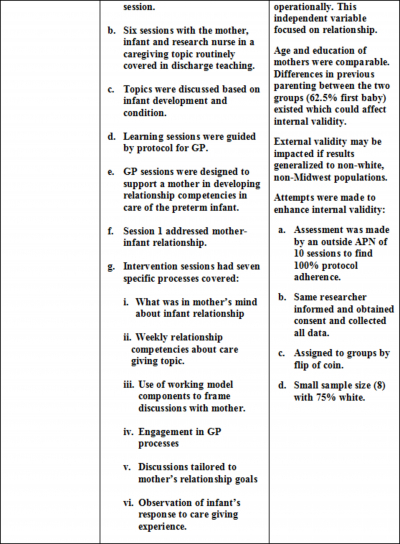
Figure v

Table 5 (Hypotheses one and 2): showed the hateful and standard deviation comparing the GP and SCT groups at baseline, 33 weeks and 35 weeks.
Figures 1 (Hypothesis 1) and Figure ii (Hypothesis 3): graphically evidence the differences between the GP and standard caregiving educational activity groups at the different assessment periods and compares the two.
Table half-dozen (Hypothesis iii): shows the progression of each of the two groups and compares based on mean score and standard deviation from baseline through each learning session.
What common terms similar `means' or percentages were used?
Mean and Standard Departure
Was the data understandable?
Yes, a higher hateful score indicated greater attunement and adjustability.
Once again, all of the points were assigned for the data preparation department. The presentation of means and standard deviations indicated the data were continuous and interval level. The variable level was noted here to assist the reader think most the statistical tests appropriate for analyzing the hypothesis. The interval level information indicated that parametric statistical testing was advisable if the assumptions of the parametric test are met.
14. Analyzing the data: (6/6 points)
What statistical technique was used to answer the key research question(s)?
The effect of the intervention over fourth dimension by group was evaluated using ANOVA which is appropriate to examine differences in three or more groups.
What was the pre-fix alpha? ___
Were the results statistically
Hypothesis one: The college scores of the GP grouping in attunement and adaptability of expectations were supported. WMRS for GP grouping:
Hypothesis two: Greater gains in development of attunement and adjustability were non supported.
Hypothesis iii: Both groups increased over fourth dimension with demonstrating greater competency in being with the babe and knowing and relating to the infant as a person. All mothers had a meaning change over time. Relationship Competency Assessment for both groups over time:
The preset alpha was .05 and each hypothesis and the results of testing using ANOVA were appropriately related.
15. Interpreting the results: (2/4 points)
Tables were helpful in visualizing the results. Each hypothesis was cleaved down. Hypothesis 1 and Hypothesis 3 has a clear description of the results. Hypothesis 2 results were more difficult to determine.
Did the results make sense?
The data were articulate that the GP group had higher human relationship competencies in interacting with their infant. The differences between each of the three hypotheses were harder to interpret.
Were the authors' findings congruent with expectations?
Yes, attunement and adaptability of human relationship with the baby would likely exist college with the GP group since the focus was interaction with the infant. Traditional teaching toward discharge care does not focus on relationship competencies.
The APRN felt that the authors were unsuccessful at clarifying how these findings apply to clinicians. Theoretical framework and procedures are somewhat complex and potentially hard for some clinicians to grasp conspicuously. Equally a upshot, data analysis and interpretation of findings may also be unclear.
16. Communicating the findings: (6/vi points)
Who should be told about these results?
Results should be conveyed to NICU intendance teams, with a focus on the NICU and pediatric nurses, who work with preterm infants and families. This data could be used to develop programs to heighten the relationship competencies of the mother and exist incorporated with daily care of the infant in the NICU.
Is this inquiry relevant to do?
Developing positive parenting competencies should be a goal in the intendance of families of NICU babies. These babies' special needs can impair interaction between the baby and parent. By developing relationship competencies while developing care competencies, positive parenting could be assisted.
Is information technology safe to use this research in exercise?
More than description on the exact program and interaction used to receive the results is needed. The commodity did not comprehend the specifics of GP, which is necessary to implement the findings of the intervention. Farther, inappropriate interaction with parents could result in harm to the relationship between the mother and infant. Therefore, the intervention is non ready for broad scale implementation.
If appropriate, codify a nursing intervention based on this inquiry. Be sure the intervention is based upon the research and is specific. Not all enquiry is ready to be used in practice.
17. Critiquing the ethics of this enquiry: (8/8 points)
IRB/HSRB: The study was approved by the human being subjects review boards of the participating academic institutions and hospitals.
Informed consent: The researcher stated informed written consent was obtained.
Run a risk versus Benefit: The researcher did not specifically accost risk versus benefit. No intendance was withheld from either group. Standard intendance instruction was washed with ane group without a specific focus on relationship competencies. An argument could be made that the standard care teaching group did not accept the advantage of human relationship competency edifice, which could impact the mother-infant relationship. No significant risk was introduced and benefit might exist obtained by studying this subject area in relation to positive parenting.
Qualified researchers: Both researchers are registered nurses. One researcher is a PhD prepared pediatric clinical nurse specialist and the other is a PhD prepared professor at a major academy-based school of nursing.
Anonymity/Confidentiality: Patients cannot be linked to the data through this article. No patients were identified, hospitals were not identified, and the time of the information collection was not identified. Information was reported in aggregate.
Full points were given to this section past the APRN. The researchers were conscientious not to provide details that would place participants and the study was approved by review boards.
What is the level of prove?
Level Two8 unmarried random controlled trial using an intervention based on formal protocols. One grouping had standard care didactics and the other had guided participation.
Comments:
The concept of the GP article was interesting. Improving parenting skills for parents of children in the NICU should exist a goal. The focus on the sick infant can influence the interaction with the infant. The strengths include a well designed study with a focus on blueprint validity and reliability of the tools. Ethical components of the written report were addressed. A weakness of the study included a small sample size that had express participation by minorities and may have excluded lower income families. The focus of the study was mothers and did non consider the effect on other family members. The study was difficult to read on first review but was easier to follow after each chemical element was explored. The results of the study were promising, demonstrating that Guided Participation impacts attunement and adaptability in the relationship with the preterm baby. More than clarification of interventions is needed to bring Guided Participation into clinical do.
Total Score: 86
Summary
The APRN summarized the review and derived a score of 86, indicating the research written report was well done. This APRN summarized the key points including the strengths and weaknesses of the inquiry. Thus, the pace past step critique process ends with the nurse generally reviewing the unabridged commodity. The use of the guide to review research reports breaks the process downward into small steps and has been evaluated equally very helpful by graduate nursing students and practicing nurses for many years. The conviction gained past regular reading and critique of research is essential in edifice the skills necessary to evaluate studies before incorporating findings into practice.
Source: https://ispub.com/IJANP/10/2/5035

Publicar un comentario for "Strategies to Review and Critique Literature in Nursing"